
Does Zyrtec Cause Hair Loss?

You reach for Zyrtec every morning without a second thought. It keeps the sneezing at bay, clears your head, and lets you get through allergy season like a functioning human being. But lately you have been noticing more hair in the shower drain or on your pillow, and now you are wondering: could my allergy pill actually be thinning my hair?
It is a surprisingly common concern. You are not imagining things, and you are not alone in asking. Let's talk through what we actually know.
The Reports Are Real, Even If the Science Is Still Catching Up
Hair loss is not listed as an official side effect of cetirizine (the active ingredient in Zyrtec) in the product labeling. But that does not mean nobody is experiencing it. According to FDA adverse event data analyzed by eHealthMe, out of more than 109,000 people who reported side effects while taking Zyrtec, about 1.59% noted hair loss. That might sound like a small number, but it adds up to roughly 1,745 people.
So the pattern exists. What is less clear is whether Zyrtec is the actual cause, or whether something else is going on.
Why You Might Be Shedding More (And It May Not Be the Pill)
Here is something worth knowing: the most common type of hair loss that follows a medication or stressor is called telogen effluvium. Think of it like a traffic jam in your hair growth cycle. Normally, your follicles cycle through growing, transitioning, and resting phases. When your body experiences any kind of disruption, whether that is illness, stress, hormonal changes, or certain medications, more follicles than usual get nudged into the resting phase at once. A few months later, you start shedding.
The tricky part? The timing delay means you might blame whatever you started three months ago, when the real trigger was something entirely different.
Some researchers have also raised the question of whether long-term antihistamine use could interfere with the absorption of nutrients like zinc or iron, both of which are critical for healthy hair growth. This is still a theoretical connection and not proven outright, but it is worth having on your radar.
The Prostaglandin Piece
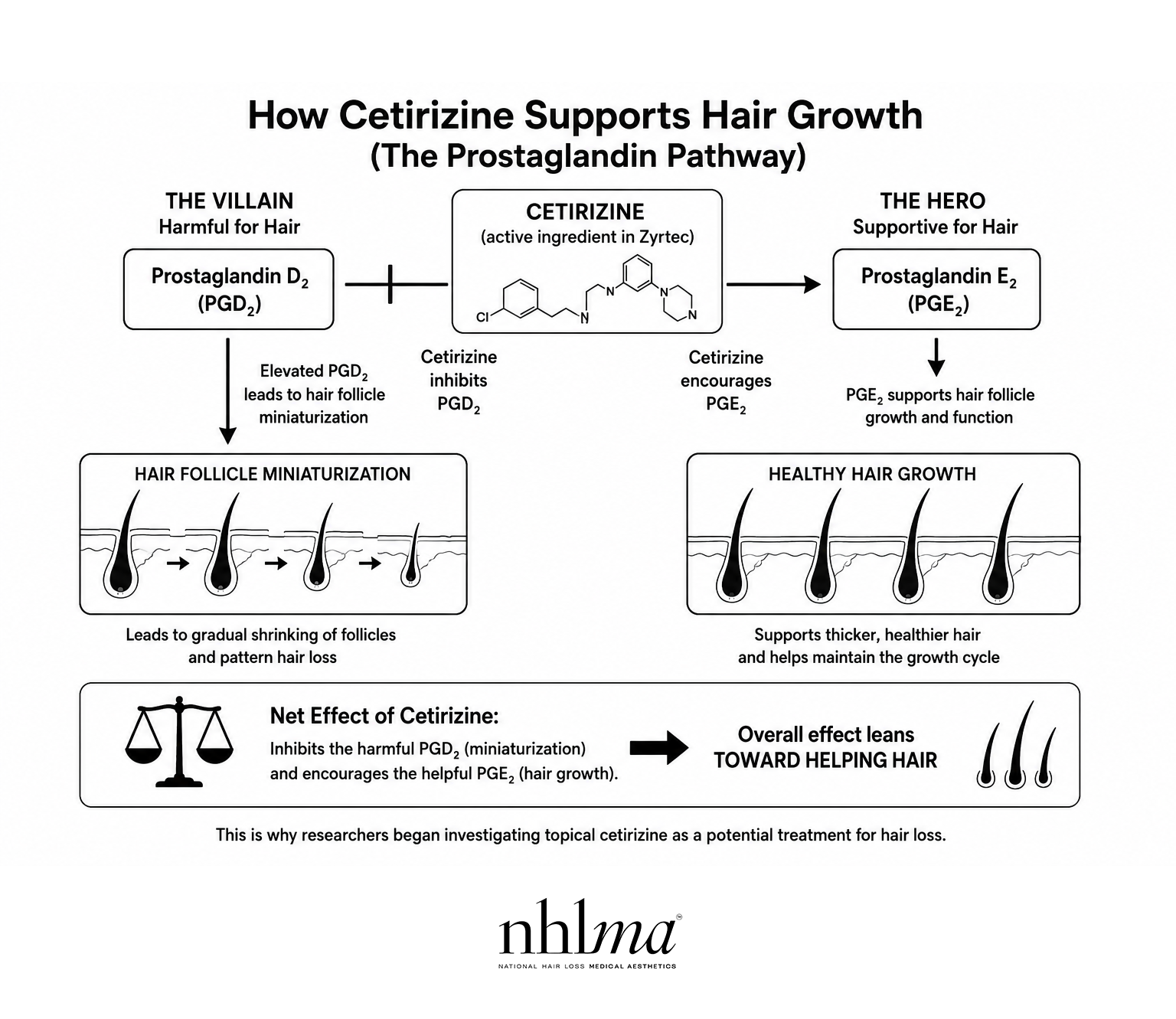
Here is where it gets more interesting. Hair follicles are influenced by chemicals called prostaglandins. Prostaglandin D2 (PGD2) is the villain of this story: elevated levels of it have been associated with hair follicle miniaturization, which is the gradual shrinking of follicles that leads to pattern hair loss. Prostaglandin E2 (PGE2), on the other hand, tends to support hair growth.
Cetirizine actually inhibits PGD2 and encourages PGE2. In plain terms: the active ingredient in Zyrtec has a chemical action that leans toward helping hair rather than hurting it. This is actually why researchers started investigating topical cetirizine as a potential hair loss treatment in the first place (more on that in a moment).
What the Research Actually Shows
If Zyrtec were straightforwardly bad for hair, you would expect studies to back that up. Instead, the research points in the other direction.
A preliminary clinical study published in the Journal of Dermatological Treatment found that topical cetirizine at 1% concentration produced meaningful improvements in androgenetic alopecia, which is the most common form of pattern hair loss. Participants saw increases in total hair density, terminal hair density, and hair diameter.
A systematic review published in 2022 pulled together the available studies on topical cetirizine for androgenetic alopecia and found consistent evidence pointing toward a benefit, while noting that more large-scale controlled trials are needed.
For men specifically, a randomized single-blind study compared cetirizine 1% solution to minoxidil 5% (the gold standard topical treatment) in male pattern hair loss. Cetirizine held its own, showing significant improvements in hair regrowth and patient satisfaction.
For women, a randomized controlled trial found that topical cetirizine produced favorable results for female pattern hair loss, particularly for those who cannot tolerate minoxidil. A double-blind placebo-controlled study also showed significant gains in terminal and vellus hair density when topical cetirizine was used alongside minoxidil.
This is important context: the version being studied is topical (applied directly to the scalp), not the oral tablet you swallow for allergies. These are meaningfully different things in terms of how the body processes them and where the compound actually ends up.

Oral vs. Topical: Two Very Different Stories
When you take an oral Zyrtec tablet, cetirizine travels through your digestive system and into your bloodstream. It does its job in your nose and eyes and skin, but it does not concentrate in your scalp the way a topically applied treatment would.
The studies showing hair growth benefits used cetirizine formulated directly for scalp application at specific concentrations. So while oral Zyrtec is unlikely to be actively growing your hair, it also has no proven mechanism for causing hair loss in a direct, consistent way.
The reports of hair shedding that do exist are more likely tied to individual sensitivities, underlying conditions, or coincidental timing with other stressors rather than a direct pharmacological effect of the drug. If you want to explore cetirizine as part of a hair restoration strategy, that is a different conversation entirely and one worth having with a specialist.
So Should You Stop Taking Zyrtec?
Not without talking to your doctor first. Stopping antihistamines abruptly can come with its own set of issues, and your allergy symptoms are real and worth managing.
What is worth doing is getting a proper evaluation of your hair loss rather than guessing at the cause. Hair shedding has dozens of possible triggers: nutrient deficiencies, thyroid function, hormonal shifts, stress, scalp inflammation, and yes, sometimes medications. The only way to know what is actually happening on your scalp is to look at the full picture.
If you are noticing thinning and want real answers, a clinical hair loss evaluation can help you pinpoint what is driving it and what to do about it. We do that every day at NHLMA.
Want to dig deeper into how allergy medications and hair health intersect more broadly? Check out our post on the allergy medication and hair loss connection.
Ready to get to the bottom of your hair loss?
Book a Hair Check with our Trichologist in Scottsdale or virtually, and walk away with real answers and a clear path forward.

Written by the Hair Loss Experts at NHLMA
Founded in 2007, National Hair Loss Medical Aesthetics is the leading Scottsdale-based practice specializing in the science of hair restoration and scalp health.
Our team of clinicians combines functional medicine, advanced diagnostics, and the latest regenerative treatments to address hair loss at its root cause. Through a clinical, evidence-based lens, not guesswork or one-size-fits-all solutions. We are not just writing about this. It is what we do every day.