
How to Track Your Hair Growth at Home the Right Way

If you are using a hair growth treatment, whether that is a topical, a supplement, or an in office regenerative treatment, the hardest part is often patience. Hair grows slowly, shedding is normal, and the mirror is a notoriously unreliable narrator. The good news is that you do not need clinical equipment to track your progress with real accuracy. You just need a consistent method.
Here is what the research and clinical practice actually support, from simple at home habits to the imaging technology used in office.
Why Tracking Matters More Than It Seems
Most of our hair restoration treatments at our Scottsdale hair clinic, from minoxidil to PRP to exosome therapy, take a minimum of three to four months before visible change appears, since that is roughly how long it takes for a follicle to move through its growth cycle. Without a consistent tracking method, it is extremely easy to lose motivation, assume a treatment is not working, and stop before it has had a real chance to show results. A good tracking system removes the guesswork and gives you an honest, dated record to compare against.
The Standardized Photo Method
This is the single most useful tool available to anyone at home. The method is simple but only works if you are strict about consistency. Changes in terms of hair growth can take time, so be patient. We suggest taking photos every 90 days, which is a realistic timeframe for most treatments to begin showing results.
Here are some basic guidelines to follow:
Choose the same location and time of day each month, ideally with natural or consistent artificial lighting.
A blank background will allow photos to remain consistent.
Use the same distance, angle, and hair part every time, since even small changes in angle can make thinning look better or worse than it is.
Take at least three angles: a top down view of the crown, a frontal hairline view, and a side profile.
Keep the photos dated in a single folder or app so you can do direct side by side comparisons every few months rather than relying on memory.
The Shed Count Method
Counting the hairs you lose in a day gives you a rough but genuinely useful data point over time. According to the American Academy of Dermatology, the average person sheds somewhere between fifty and one hundred hairs daily as part of a normal growth cycle, so the goal is not a single day's count but a trend over several weeks.
A simple version of this method involves washing daily for 7 days straight and then, on day 8, collecting shed hairs from your brush, pillow, and shower drain and logging the count. That day 8 count becomes your normal shedding baseline. A consistent upward trend over several weeks can indicate a flare or shedding phase, while a downward trend over months is a good sign that a treatment is working.
The Tape Measurement Method
For people focused on length rather than density, marking a fixed reference point, such as a specific section of hair near the crown, and measuring from root to tip with a soft tape measure at the same interval each month can track growth rate directly. This method is more useful for overall hair health and growth speed than for detecting thinning or density changes.
Hair Tracking Apps
A newer category of tools uses your phone camera along with image analysis software to give more objective numbers than the naked eye can. Apps in this space can detect hair thickness, estimate density from a photo, and build a timeline that flags gradual changes a person might otherwise miss. These tools are a meaningful upgrade from simply eyeballing progress photos, though independent, peer-reviewed validation of most consumer apps is still limited, so they are best treated as a helpful trend tool rather than a clinical-grade measurement.
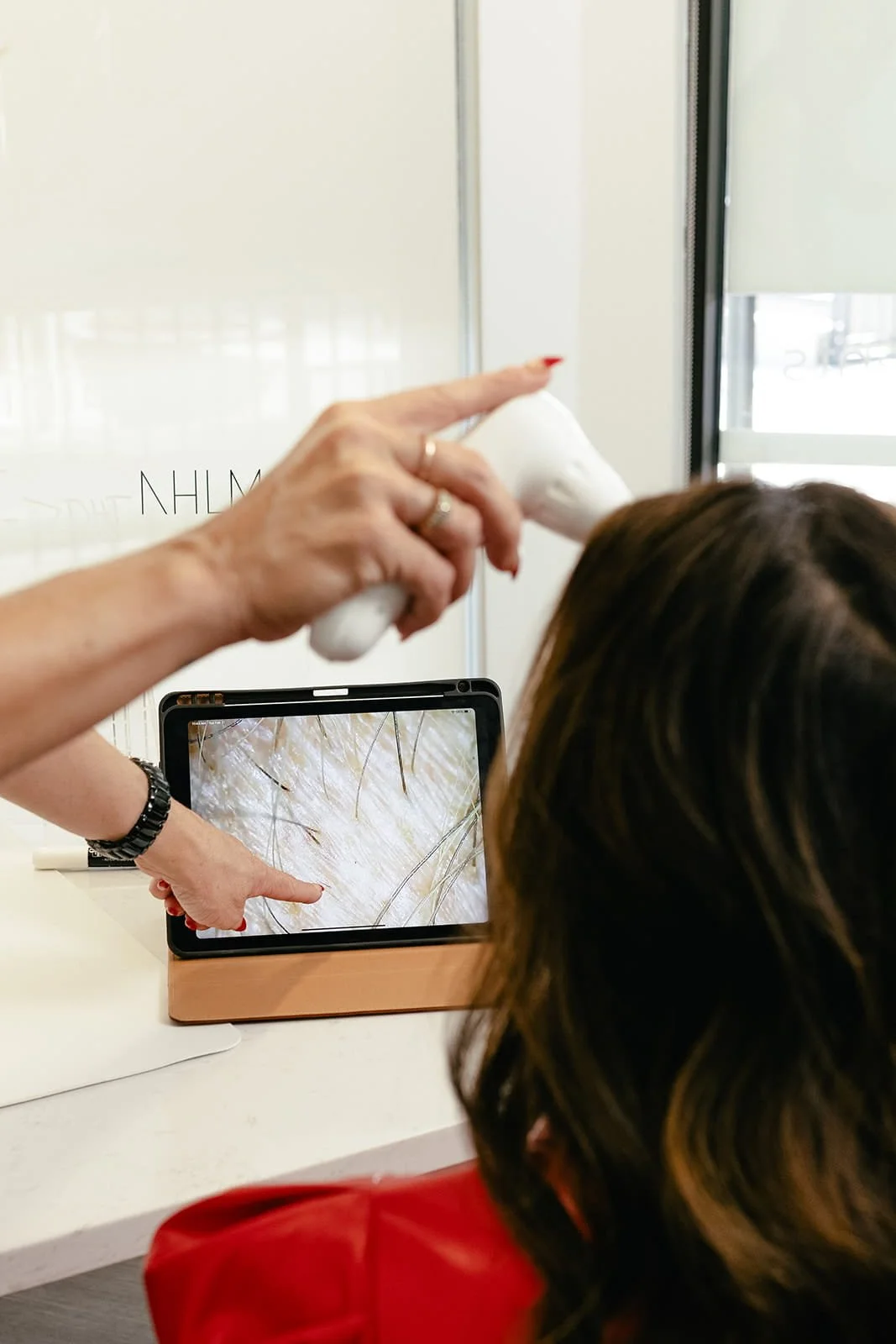
When to Move to Clinical Trichoscopy
At home methods are genuinely useful, but they have a real limit. The human eye, and even most phone cameras, cannot reliably detect hair miniaturization, the gradual thinning of individual hair shafts that is often the earliest sign of pattern hair loss, long before it becomes visible as reduced density.
Trichoscopy uses a specialized magnifying camera called a trichoscope to capture highly detailed images of the scalp and individual follicles. Software then counts and measures the hairs in the image, providing objective density numbers and detecting early miniaturization that would otherwise go unnoticed. A related method called a phototrichogram involves shaving a small, defined patch of scalp and photographing it over time to precisely measure growth rate and the ratio of growing to resting follicles in that area.
These clinical methods are the most accurate way to confirm whether a treatment plan is actually working at the follicle level, not just at the level of what you can see in the mirror.
Building a Simple Tracking Routine
A realistic, sustainable approach for most people combines a standardized photo set every 90 days, a rough weekly shed count kept in a notes app, and a periodic clinical check in, ideally every three to six months, using trichoscopy to confirm what your at home tracking is showing.
The NHLMA Approach
Patience is genuinely the hardest part of any hair restoration services and plan, and objective tracking is what makes that patience easier. During your visits, our team uses clinical trichoscopy to give you real density and miniaturization data rather than a subjective impression, so you always know whether your PRP, exosome, or scalp treatment plan is working long before it becomes obvious in the mirror. Pairing that clinical data with your own consistent at home photo and shed tracking gives you the most complete picture available.
Frequently Asked Questions
What is the most accurate way to track hair growth at home?
A standardized monthly photo taken from the same angle, distance, and lighting is the most reliable at home method, since it removes the memory bias that makes day to day changes hard to judge accurately.
Is counting shed hairs a reliable way to track hair loss?
It is useful as a trend indicator rather than a precise measurement. Shedding fifty to one hundred hairs daily is considered normal, so the goal is tracking whether your weekly count is trending up or down over time, not judging a single day in isolation.
What is Trichoscopy evaluation at NHLMA?
A hair loss expert will look at your scalp under a 50-100x microscope to determine density, inflammation, dormant follicles, and reasons for hair loss not seen by the naked eye.
Can hair tracking apps replace a dermatologist or trichologist visit?
Not entirely. Apps can meaningfully improve on the naked eye by analyzing photos for thickness and density trends, but they cannot detect microscopic follicle miniaturization the way clinical trichoscopy can, so they work best as a complement to periodic professional checks rather than a full replacement.
How soon should I expect to see visible results from PRP or exosome treatments?
Most regenerative hair treatments require three to four months before visible change appears, since that reflects the natural timeline of the hair growth cycle. Consistent tracking during this window helps confirm progress that might not yet be obvious in the mirror.
Sources
"Do you have hair loss or hair shedding?"American Academy of Dermatology.
"Automated Digital Image Analysis (TrichoScan) for Human Hair Growth Analysis: Ease Versus Errors."PMC.
"Trichoscopy of Androgenetic Alopecia: A Systematic Review."PMC.
"Exploring the Advancements and Applications of AI-Powered Hair Analysis Tools."The Journal of Clinical and Aesthetic Dermatology.

Written by the Hair Loss and Skin Experts at NHLMA
Founded in 2007, National Hair Loss Medical Aesthetics is the leading Scottsdale-based practice specializing in the science of hair restoration and medical aesthetics.
At NHLMA in Scottsdale, our clinicians don't guess. They diagnose. Using functional medicine, advanced diagnostics, and the latest regenerative treatments, our team identifies what your skin actually needs. Then builds a protocol around it. This is what we do every day.