
Iron Deficiency and Hair Loss: What Your Labs Might Be Missing
We hear this all the time from patients. The hair has been shedding for months. They went to their doctor, got bloodwork done, and were told everything looks fine. So they assumed iron was not the issue and moved on.
Here is the problem with that. The standard iron test most doctors run and the test that actually tells you whether iron is affecting your hair are two different things. And a lot of women and men are walking around with a real, treatable cause of hair loss that never got properly identified because the right number was never checked.
Your Body Prioritizes Your Hair Last
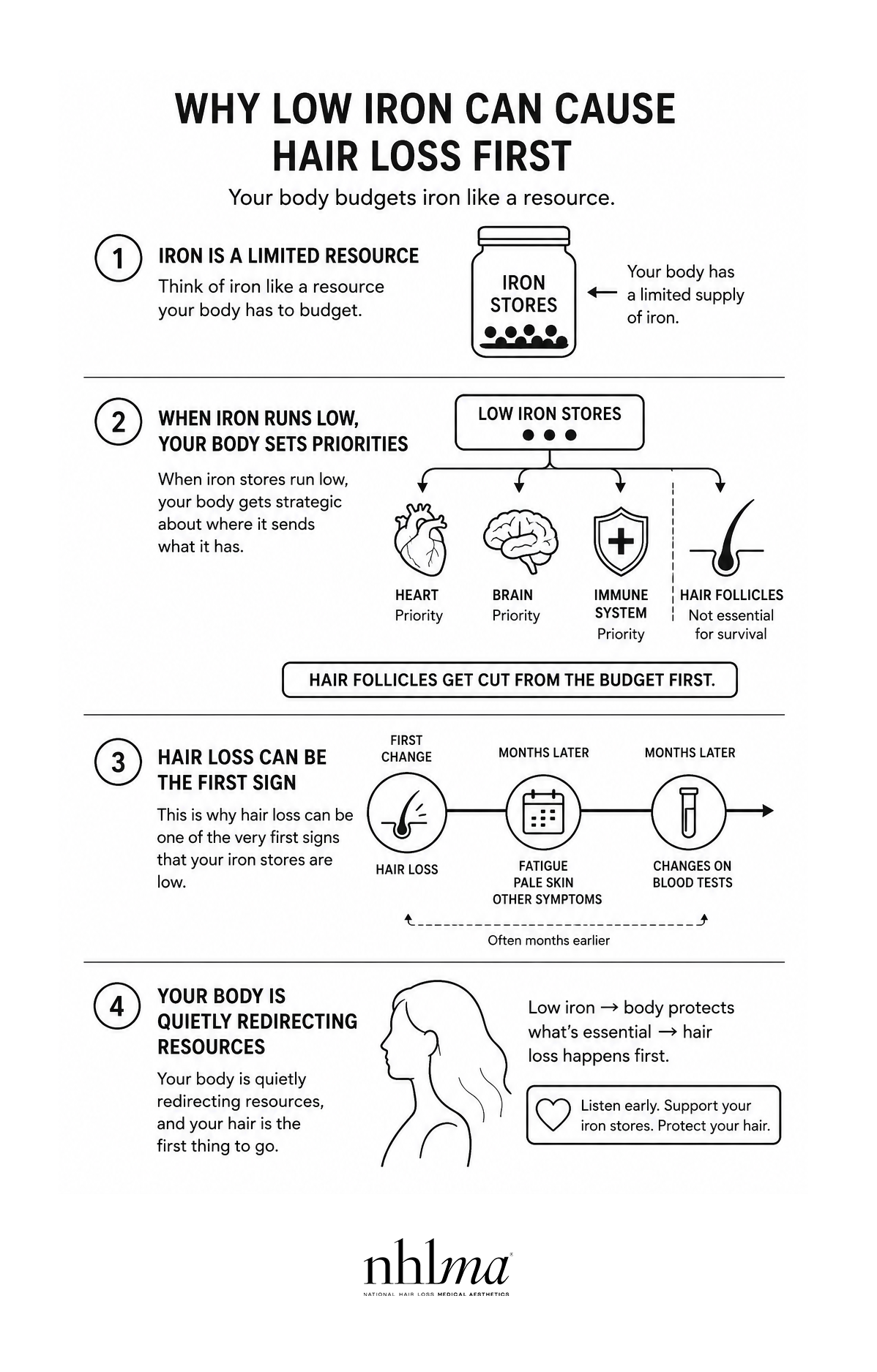
Think of iron like a resource your body has to budget. When iron stores run low, your body gets strategic about where it sends what it has. The heart, the brain, the immune system, those get priority. Hair follicles, which are not essential for survival, get cut from the budget first.
This is why hair loss can be one of the very first signs that your iron stores are low, often showing up months before you feel tired, look pale, or show anything else on a standard blood test. Your body is quietly redirecting resources, and your hair is the first thing to go.
The Difference Between Iron and Ferritin
This is the piece that most standard lab work misses, and it is important to understand.
Serum iron is the iron currently moving through your blood at the moment the blood is drawn. It is a snapshot, and it can look completely normal even when your body's iron reserves are nearly empty.
Ferritin is the stored iron. Think of it as the reserve tank. It is what your body draws from when current supply runs low. And it is a much better indicator of whether you have enough iron to support hair growth over time.
You can have normal serum iron and critically low ferritin at the same time. In that state, your body is running on empty even though the snapshot looked fine. This is sometimes called non-anemic iron deficiency, and research confirms it causes real symptoms, including significant hair shedding. It is also the reason why "your iron looks normal" is not always the complete answer.
What the Research Actually Shows
The science on this is clear and consistent.
A large analysis of 36 studies involving more than 10,000 women found that those experiencing hair loss had significantly lower ferritin levels than women who were not. A separate study of 155 women presenting with hair loss found that iron deficiency was the primary contributing factor in 70% of cases. That is a significant majority.
One study found that when ferritin falls to 30 or below, women are twenty-one times more likely to experience diffuse hair shedding compared to women with adequate levels. Twenty-one times. That is not a minor association.
A 2023 clinical review specifically concluded that ferritin is the most useful iron marker to check in anyone experiencing hair loss, and that standard iron testing alone is not enough to rule it out.
The "Normal" Range on Your Labs Is Not the Same as Optimal for Hair
This is where things get frustrating for a lot of patients, and understandably so.
Most lab reports consider ferritin "normal" if it is above 12 to 15 ng/mL for women. So a ferritin of 16 technically passes. But research consistently shows that hair growth requires ferritin to be between 40 and 70 ng/mL to function well.One study of 200 women with chronic hair shedding found that 95% of them had ferritin below 70 ng/mL.
In other words, a number that clears the lab's threshold can still be far too low to support healthy hair growth. A ferritin of 18 looks fine on paper. In our practice, it is something we address.

What to Ask For at Your Next Appointment
If you want to know whether iron is a factor in your hair loss, here is what to specifically request from your provider.
Ferritin is the most important one and the most commonly skipped. Ask for it by name because it is not automatically included in most standard panels. Serum iron and TIBC (total iron binding capacity) give useful context alongside ferritin. A complete blood count checks for full anemia. And C-reactive protein (CRP) is worth adding because it helps interpret the ferritin result accurately since inflammation can make ferritin appear higher than it actually is.
The short version: ask your doctor specifically for ferritin. That one number can change the entire conversation.
What Happens If Your Ferritin Is Low
The encouraging thing about iron-related hair loss is that it is one of the most straightforward causes to treat once it is identified.
Most patients start with iron supplementation. A few things that make a real difference in how well it works: taking it with vitamin C significantly improves absorption, while taking it with calcium or coffee significantly reduces it. Getting those details right speeds up the process.
Hair takes time to respond. Most patients see shedding slow down and new growth begin to appear over three to six months as ferritin levels rebuild.Research suggests that starting treatment sooner rather than later leads to better outcomes, so if you suspect this is a factor for you, it is worth getting checked sooner.
Iron Is Often One Piece of a Bigger Picture
It is worth saying that iron deficiency is one of the most common things we find in our patients, but it is rarely the only thing. Thyroid issues, hormonal changes, vitamin D deficiency, and stress can all affect hair growth at the same time. Treating iron alone when multiple factors are in play tends to produce partial results at best.
This is why we look at the full picture rather than checking a single number and calling it done. When we understand everything that is going on, we can build a plan that actually works.
If you have been told your labs are normal but your hair is still shedding, it may be worth getting a second look from someone who specializes in this. That answer might not be as complete as you were told.
How Our Hair Loss Experts Help in Scottsdale and Virtually
At NHLMA, every hair loss evaluation starts with comprehensive labs because we know that the standard panel and the right panel are often different things. Ferritin is always part of what we check, and we look at everything in the context of your full history and scalp health.
If you are ready to get some real answers, book a consultation at our Scottsdale location. We will look at the whole picture and tell you honestly what we find.

Written by the Hair Loss Experts at NHLMA
Founded in 2007, National Hair Loss Medical Aesthetics is the leading Scottsdale-based practice specializing in the science of hair restoration and scalp health.
Our team of clinicians combines functional medicine, advanced diagnostics, and the latest regenerative treatments to address hair loss at its root cause. Through a clinical, evidence-based lens, not guesswork or one-size-fits-all solutions. We are not just writing about this. It is what we do every day.