
Peptides vs Retinol: Which Ingredient Wins for Aging Skin
If you have spent any time researching anti aging skincare, you have run into this debate. Peptides and retinol are the two most clinically supported ingredients for reducing fine lines, restoring firmness, and rebuilding collagen. Patients frequently ask us at NHLMA which one they actually need.
The honest answer is that they work through different mechanisms, and for most people the best routine includes both, used strategically. Here is what the research actually shows.
How Retinol Works
Retinol is a form of vitamin A. Once applied, skin enzymes convert it into retinoic acid, the active form that binds to nuclear receptors inside your skin cells. This directly changes gene expression, speeding up cell turnover and stimulating production of type I and type III collagen in the dermis.
Clinical studies consistently show retinol meaningfully reduces the appearance of fine lines and wrinkles over time. A landmark trial published in the New England Journal of Medicine found that tretinoin restored collagen formation in photodamaged human skin, and it remains one of the most researched anti aging ingredients available, backed by decades of dermatological data.
The tradeoff is tolerance. Retinol can cause redness, peeling, dryness, and increased sun sensitivity, particularly when you are new to it or using a higher concentration than your skin can handle.
How Peptides Work
Peptides are short chains of amino acids that act as signaling molecules. Rather than altering gene expression directly, they send messages to fibroblasts, the cells in your dermis responsible for producing collagen and elastin. This strengthens your skin's extracellular matrix and improves elasticity over time.
Clinical research on specific peptides backs this up. A foundational study on palmitoyl pentapeptide-4 (commonly known as Matrixyl) documented visible reductions in wrinkles and improved skin elasticity in photoaged skin. More recent research on copper peptides (GHK-Cu) recorded an average 28 percent increase in collagen density after twelve weeks, with top responders seeing up to 51 percent, a result that holds up well against what many people expect from retinol alone.
The major advantage of peptides is tolerability. They are generally associated with minimal to no irritation, making them a strong option for sensitive skin, patients recovering from procedures, or anyone who cannot tolerate a consistent retinol routine.
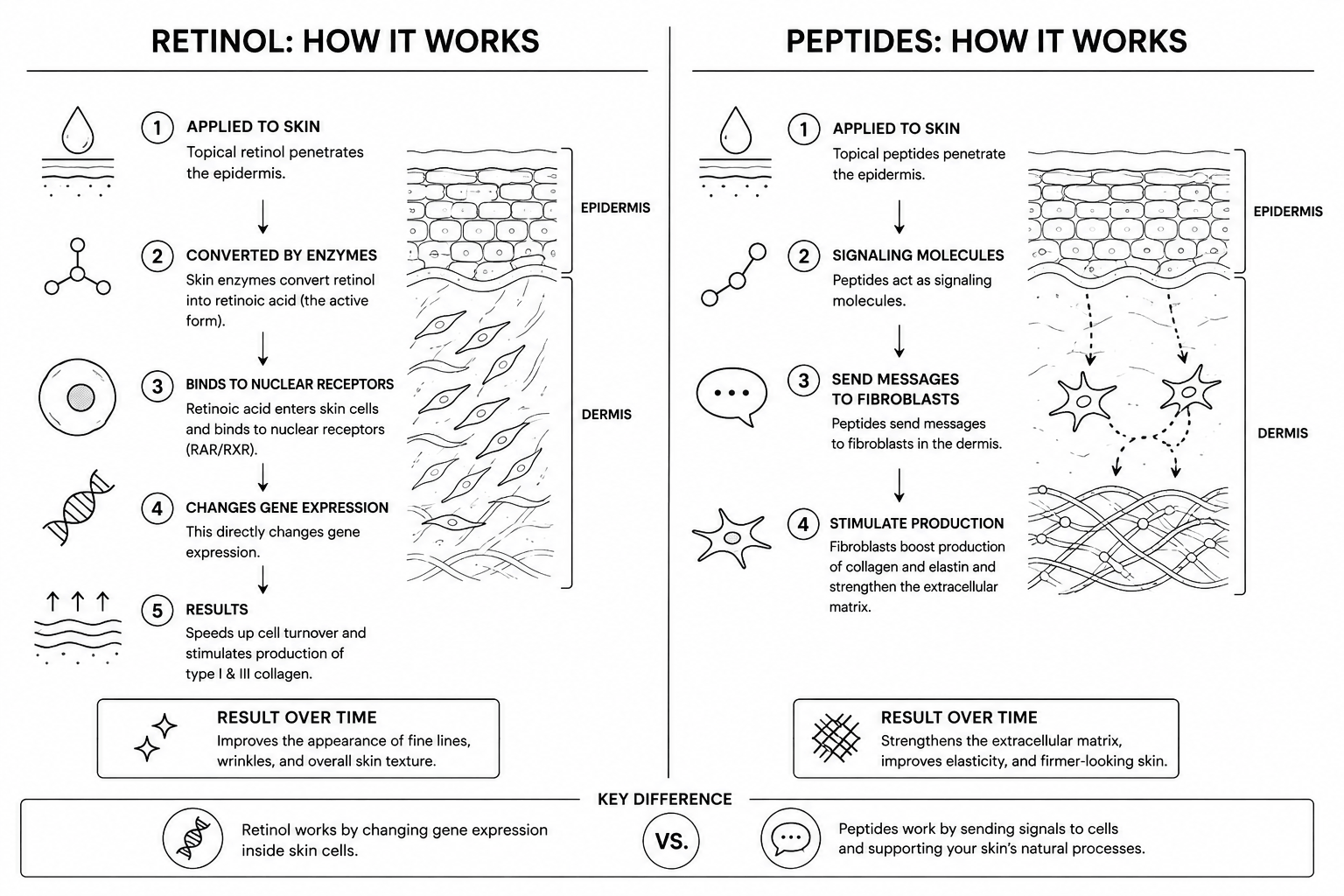
Peptides vs Retinol: A Side by Side Look
Mechanism:
Retinol changes cell behavior at the gene level.
Peptides send signaling messages to collagen producing cells.
Speed of visible results:
Retinol often shows results within a similar twelve week window, though initial purging or irritation can occur first.
Peptides tend to work gradually with little to no downtime.
Sensitivity profile:
Retinol frequently causes irritation, especially at higher strengths.
Peptides are well tolerated by nearly all skin types, including reactive and post procedure skin.
Best used for:
Retinol is well suited for deeper wrinkles, sun damage, and cell turnover concerns.
Peptides are well suited for barrier support, sensitive skin, and long term collagen maintenance.
Can You Use Both Together
Yes, and many dermatologists consider this the ideal approach. Peptides can help fortify the skin barrier and reduce inflammation, which may actually improve how well your skin tolerates retinol. Some patients use peptides to maintain results between retinol cycles, or as a full replacement when retinol becomes too irritating.
A common and effective routine is applying peptide serum in the morning to support barrier function throughout the day, then introducing retinol in the evening a few nights per week, building up tolerance gradually.
What This Means for Your Routine
There is no single correct answer, because the right choice depends on your skin's tolerance, your goals, and what other treatments you are combining it with. If you have sensitive or post treatment skin, a compromised barrier, or you are new to active ingredients, peptides are the lower risk starting point. If you are targeting deeper lines, texture, and sun damage, and your skin tolerates actives well, retinol offers strong, well documented results.

The NHLMA Approach
Our clinical skincare line includes a growth factor serum built around biomimetic peptides, neuropeptides, and oligo elements, formulated to support both facial skin and scalp health without the irritation that often comes with high strength actives. For patients who want to incorporate retinol, our team can help you build a routine that layers both ingredients safely and effectively, based on your skin's actual needs rather than a generic regimen.
The best way to know which ingredients your skin actually needs is to have it assessed by someone who understands the science behind them. Book a skincare consultation at our Scottsdale med spa, and our skincare experts will evaluate your skin in person and build a personalized peptide and retinol routine around your goals, not a generic regimen.
The science is not peptides against retinol. It is understanding what each one does, so you can build a routine that actually works for your skin.
Frequently Asked Questions
Can I use peptides and retinol at the same time?
Yes. Many dermatologists consider this the ideal approach. Peptides can help fortify the skin barrier and reduce inflammation, which may improve how well your skin tolerates retinol, and some patients use peptides to maintain results between retinol cycles.
Which ingredient works faster, peptides or retinol?
Retinol often shows visible results within about twelve weeks, though initial irritation or purging can occur first. Peptides tend to work more gradually over a similar or slightly longer window, with little to no irritation along the way.
Are peptides safe for sensitive or post procedure skin?
Peptides are generally associated with minimal to no irritation, which makes them a strong option for sensitive skin, patients recovering from procedures, or anyone who cannot tolerate a consistent retinol routine.
Do peptides actually build collagen the way retinol does?
Yes, though through a different mechanism. Clinical research on peptides like Matrixyl and copper peptides (GHK-Cu) has shown meaningful increases in collagen synthesis and density, in some trials up to 51 percent after twelve weeks, a result that holds up well against what many people expect from retinol alone.
Should I choose peptides or retinol if I am new to active ingredients?
Peptides are generally the lower risk starting point since they carry a much lower chance of irritation. Retinol can be introduced gradually afterward, once your skin has built a stronger barrier.
Sources
Kligman, A.M., et al. "Restoration of Collagen Formation in Photodamaged Human Skin by Tretinoin (Retinoic Acid)." New England Journal of Medicine, 1993.
Kong, R., et al. "A comparative study of the effects of retinol and retinoic acid on histological, molecular, and clinical properties of human skin." Journal of Cosmetic Dermatology, 2016.
Robinson, L.R., et al. "Topical palmitoyl pentapeptide provides improvement in photoaged human facial skin." International Journal of Cosmetic Science, 2005.
"Epigenetic mechanisms activated by GHK-Cu increase skin collagen density in clinical trial." EurekAlert, 2023.

Written by the Hair Loss and Skin Experts at NHLMA
Founded in 2007, National Hair Loss Medical Aesthetics is the leading Scottsdale-based practice specializing in the science of hair restoration and medical aesthetics.
At NHLMA in Scottsdale, our clinicians don't guess. They diagnose. Using functional medicine, advanced diagnostics, and the latest regenerative treatments, our team identifies what your skin actually needs. Then builds a protocol around it. This is what we do every day.